The Israeli-Palestinian Conflict
(1948 to the Present Day)
The Israeli-Palestinian Conflict—(1948- Present):
The ongoing conflict between Israel and the Palestinians is both simple to understand, yet deeply complex. At the heart of this conflict is a basic idea that both sides believe: The Israelis believe that they are entitled to the land now known as Israel, while the Palestinians believe that they are entitled to the land they call Palestine. Unfortunately, both sides claim the same land; they simply call the land by different names. For religious Jewish Israelis and religious Muslim Palestinians, the belief is deeper still, for both sides believe that God (called Jehovah by the Jews and Allah by the Muslims), gave them the land, and that to give it away or to give it up to another people is an insult to God and a sin.
The history of the conflict is much more complex than that simple explanation, but the religious and historical differences are very important to this story. On another level, the reasons for the continual fighting is easy to understand. They have been fighting for over 60 years, and each war, each death, each act of terrorism, only deepens the hatred and the reluctance to give in to the other side.
In the Beginning…
Historically, the ancient Jews from Biblical times called their land Israel, Canaan, Judea, Samaria, Galilee and other long-ago names. Modern Jews, and quite a few Christians, believe that in the days of the Bible and the Torah, God gave this land to the ancient Jews (also known as Hebrews), led by men such as Abraham, Moses, David, and others. About 2,000 years ago, the Roman Empire ruled this area, and in suppressing several Jewish rebellions, the Romans destroyed the Jewish temple in the city of Jerusalem, killed large numbers of Jews, and forced many others to leave their homeland in an exodus called “The Diaspora.” Some Jews remained in the area, but large numbers of Jews did not return until the 19th and 20th Century, especially after World War Two and the Holocaust.
This is where the real trouble began between the Jews, who began calling themselves “Israelis” after their old name for their ancient homeland of Israel, and the Arab population of the area who came to be known as “Palestinians,” after the old Roman and Greek name for the area. In the two thousand years after most of the Jewish population was killed off by the Romans or forced to leave, Arabic-speaking Muslims became the dominant ethnic group. According to records of the Ottoman Empire, which ruled Palestine for several centuries, in the year 1900, the population of Palestine was 600,000, of which 94% were Arabs. While many Arabs were willing to sell land to the incoming Jews, many other Palestinian Arabs were worried about becoming a minority in a country they considered their own.
In the 1930s, the Great Arab Revolt took place against the British, who ruled Palestine after 1918. The Arab Revolt was directed at both the British and the growing Jewish population. It should be noted that while large numbers of Jews moved to Palestine in the 1940s, a movement called “Zionism” began in the late 1800s, which influenced many Jews from around the world to move to Palestine to reclaim their ancient “homeland” of Israel. Thus, by the 1930s, the numbers of Jews had risen to a point that alarmed many Palestinian Arab leaders. The British put down the revolt with the help of Jewish militias, but the fighting and hostility never really ended between the Jews and Arabs. From that point on, both the Jews and the Palestinians formed militias and other military units to fight each other and to prepare for the day when the British would leave.
http://www.cia.gov/cia/publications/factbook/geos/is.html
In 1948, the British did leave, and the Jews in Palestine declared the independence of the new State of Israel. The neighboring Arab nations of Egypt, Saudi Arabia, Transjordan, Syria, Lebanon, and Iraq invaded Israel to aid the Palestinian Arabs who were fighting to create their own nation. The Arabs lost that war (see Arab-Israeli Wars), and the Palestinian diaspora began, as hundreds of thousands of Arabs fled the new nation of Israel and moved to neighboring Arab nations to live as refugees, awaiting the day when they could return to their homeland. This loss and the exile of these Palestinians is known in the Arabic world as “al-Nakba,” or “The Cataclysm.”
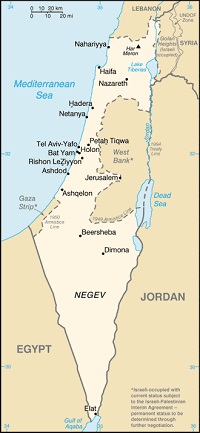
Two significant parts of the old Palestine did not become part of the new Israel; the a small, crowded coastal area around the city of Gaza, which came to be called the Gaza Strip, and the West Bank. The West Bank is a section of the old Palestine on the west side, or bank, of the Jordan River. The Arab nation of Jordan sits on the east side, or bank, of that river. After the war ended in 1949, Egypt took over the Gaza Strip, while Jordan took control of the West Bank.
In the 1950s and 1960s, Palestinians conducted cross-border raids into Israel, often with the aid of Egypt, Jordan, and Syria. These attacks prompted Israeli military reactions, and the entire border area, especially around Gaza and the West Bank, was often the scene of violent warfare. (see Arab-Israeli Border Wars).
The conflict between Israel and the Palestinians reached a new level of intensity and complexity on December 31, 1964, with the first al-Fatah raid into Israel from Lebanon. al-Fatah is a Palestinian political and military group formed in the late 1950s with the aim of retaking Palestinian land from Israel. Led by Yasser Arafat, the group joined the Palestine Liberation Organization (PLO) in June of 1964.
For more information on how the Israeli-PLO conflict progressed from 1964 through the present day, go to The History Guy: Israeli-PLO Battles and Campaigns.
For information on the ongoing conflict between Israel and the Palestinian group called Hamas, go to Gaza Wars (2008-Present), which is regularly updated to reflect the ongoing battles in and around Gaza, including the new 2023 Gaza War between Israel and Hamas.
PREDECESSOR: (Related conflicts and events that occurred before)
The Great Arab Uprising (1936-1938)
CONCURRENT: (Related conflicts occurring at the same time)
1948 Arab-Israeli War (1948-1949)
Suez/Sinai War(1956)
1967 Arab-Israeli War (1967)
War of Attrition (1968-1970)
1973 Arab-Israeli War (1973)
Jordanian Civil War (1970-1971)
Lebanese Civil War (1975-1992)
Israeli Invasion & Occupation of South Lebanon (1982-2000)
Second Persian Gulf War/Operation Desert Storm (1990-1991)
Third Persian Gulf War/ Iraq War (2003-Present)
SUCCESSOR: (Related conflicts that occur later)
One Arab-Israeli war seems to lead to other, future wars between Israel and the Arabs
Links on the Israel-Palestine Conflict:
| Palestinians’ Rift Prevents Gazans From Traveling to Mecca–New York Times, Dec. 4, 2008 |
| Nakba–Recounts al-Nakba (Arabic for “The Cataclysm”) in which large portions of the Palestinian population fled Palestine during the 1948-1949 Arab-Israeli War. |
| Fateh Online–English language version of the al-Fatah movement’s website. |
| BBC NEWS | In Depth | Israel and the Palestinians –Objective information from the BBC. |
| The Electronic Intifada –Official website of the Palestinian National Authority. |
| Middle East 101 –Click on “Sticking Points” for a succinct rundown of the issues from both sides, courtesy of the Christian Science Monitor. |
| Mideast: Centuries of Conflict –CNN’s In-Depth Special makes a good starting point for background information and news. Go to “Maps: Occupied lands” for a helpful clickable map of the disputed regions. |
Copyright © 1998-2023 History Guy Media; Last Modified: 10.10.23
“The History Guy” is a Registered Trademark.