|
The
3rd Persian Gulf War (The
Iraq War) Also
see: Medals
of Honor Awarded for the Wars in Iraq and
Afghanistan--Controversy swirls
over small number of Medals of Honor
awarded in current
wars.-*NEW* On March
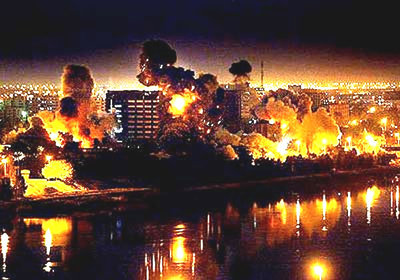
19, 2003, American and British forces
began the Third Persian Gulf War, a
conflict which became popularly known as
"The Iraq War." The U.S. government
referred to this conflict "Operation Iraqi
Freedom." Regardless of what it is called,
this conflict is by far the first truly
major war of the 21st Century. While
considered by many to be another part of
the "War on Terror," it is in many ways
separate and unique in its own right. In
scope of preparation and potential
consequences, the new war in Iraq by far
overshadows the earlier invasion of
Afghanistan. **Note:
The History Guy Website considers this the
Third Persian Gulf
War, following two previous major
international wars involving Iraq in the
Persian Gulf region. The First
Persian Gulf War lasted from 1980
to 1988 and pitted Iraq against Iran.
The Second Persian Gulf War
began in 1990 with Iraq's invasion and
occupation of Kuwait and ended in 1991
with a Coalition of nations under United
Nations authority and led by the United
States which forcibly ejected the Iraqi
military from Kuwait. Page
Menu
:Click
on the menu bar below to navigate this
page. NAME
OF CONFLICT: The Third Persian Gulf
War ALTERNATE
NAMES: The War on Iraq, "Operation
Iraqi Freedom", The Second U.S.-Iraq War,
Gulf War II (US), "Operation Telic", 5th
Anglo-Iraq War (UK), "Operation Falconer"
(AUS) **Nations
and groups in red
denote
actual combat involvement thus
far. vs. The
Iraqi regime of Saddam Hussein, Ansar
al-Islam (Supporters of Islam)
terrorist/guerrilla
group
& Komala Islami Kurdistan (Islamic
Society of Kurdistan)
terrorist/guerrilla
group, Kata'ib
Hezbollah
Iranian-supported Shia terrorist/guerrilla
group BEGAN:
March 19, 2003 -Coalition bombing of Iraq
began ENDED:
December 15, 2011 -U.S. Withdrawal
Officially ends. TYPE(S)
OF CONFLICT: Inter-State PREDECESSOR:
(Related conflicts which occurred
before) Iraqi
Shiite Revolt of 1991 Iraqi
Kurdish Revolt of 1991 The
"No-Fly Zone
War"
(1991-2003) CONCURRENT:
(Related conflicts occurring at the same
time) SUCCESSOR:
(Related conflicts that occur
later) There are
several basic reasons for the second major
war between a United States-led coalition
and Iraq. First, there was the lingering
tension and hostility left over from the
Gulf
War
of 1991, in which Iraqi occupation troops
were forced out of Kuwait. As a result of
this war, the Iraqi government agreed to
surrender and/or destroy several types of
weapons, including SCUD missiles and
various Weapons of Mass Destruction
(WOMDs). The United Nations were allowed
to send weapons inspectors to confirm the
destruction of Iraqi weapons and also to
search for prohibited weapons believed to
be in hiding. Also, two "No Fly Zones"
were established over northern and
southern Iraq for the protection of Iraqi
minority groups in opposition to the
Saddam
Hussein
government. Over these two zones, Allied
aircraft patrolled the air in order to
prevent Iraqi aircraft from attacking
northern Kurds or southern Shiites. Over
the years, Iraqi air-defense forces fired
missiles and other weapons at the Allied
warplanes (mostly American and British
planes) in unsuccessful attempts to shoot
them down. In response to these attempted
shoot-downs, Allied warplanes often
responded by bombing the air-defense sites
and the radar installations associated
with them. (see outside link:
http://www.ccmep.org/usbombingwatch/)
In 1998, under Iraqi pressure, the UN
weapons inspectors left Iraq, prompting
the United States to launch a severe
three-day bombing campaign called
"Operation Desert Fox." Following this,
Iraqi forces significantly increased
attempts to challenge the Allied planes
patrolling the No-Fly Zones, thereby also
causing an increase in the Allied bombing
of Iraqi targets. Second,
following the terrorist attacks on the
United States on September 11, 2001,
President George W. Bush's rhetoric
implied an (as yet unproven) Iraqi
connection with al-Qaida. Using the
potential threat of Saddam-supplied
Weapons of Mass Destruction in the hands
of terrorists, the U.S. government
increasingly insisted on total Iraqi
disarmament. With initial backing by the
UN Security Council, the United States
encircled Iraq with growing military
forces, leading Iraq to permit UN weapons
inspectors back into the country. By early
2003, however, the U.S. and British
governments claimed that Iraq was not
cooperating fully with the UN inspectors.
(more
detail on the inspectors and the UN
debates to follow as time
allows) On Monday,
March 17, 2003, President Bush issued an
ultimatum for Saddam Hussein and his sons
to enter into exile within 48 hours or
face military conflict. Saddam defiantly
refused, thereby setting the stage for
Bush's order for war to begin. DESCRIPTION/TIMELINE
OF CONFLICT: On March
19, 2003, at 5:34 AM in Iraq, (6:34 PM on
the U.S. West Coast), U.S. Stealth bombers
and Tomahawk Cruise Missiles struck
"leadership targets" in and around the
Iraqi capital of Baghdad to begin the
second major war between a United
States-led Coalition and Saddam Hussein's
Iraq. Soon thereafter, air attacks began
against Iraqi targets in southern Iraq,
followed by missile attacks from Iraq
toward U.S. military positions in the
Kuwaiti desert. The stated goals of the
Coalition were the disarmament of Iraq and
the overthrow of Saddam Hussein and his
Baath political party. On the
first full day of the war, March 20, U.S.
and British ground forces advanced into
southern Iraq, entering the port city of
Umm Qasr, near the major Iraqi city of
Basra, while a second wave of air attacks
hit Baghdad. Over the next several days,
Iraqi militia (known as the Saddam
Fedayeen), and holdout troops continued to
resist Coalition forces, inflicting
several casualties. By March
23, Coalition forces had seized H-2 and
H-3, airfields in western Iraq, and
controlled parts of Umm Qasr, Basra and
Nasiriyah. Armored and mechanized forces
had advanced to within 100 miles of
Baghdad and forced a crossing of the
Euphrates River at Nasiriyah, where Iraqi
forces put up a stiff fight. In northern
Iraq, the U.S. launched an attack with 40
to 50 cruise missiles on forces of two
Islamist parties opposed to the Pro-U.S.
Patriotic Union of Kurdistan (PUK). These
two groups are Ansar al-Islam (Supporters
of Islam), believed associated with Osama
bin Laden's al-Qaida and Komala Islami
Kurdistan (Islamic Society of Kurdistan).
Also on March 23, U.S. forces began
airlifting troops into Kurdish-controlled
northern Iraq in what appears to be the
opening move toward a second front against
Iraqi forces. Also on
March 23, Iraqi forces ambush the U.S.
Army's 507th Maintenance
Company. March 27:
Fierce fighting erupts in the city of
Samawah, where U.S. forces are faced by up
to 1,500 Iraqi irregulars at a vital
bridge over the Euphraties River. U.S.
forces eventually take control of the
bridge and continue the advance to
Baghdad. In northern Iraq, approximately
1,000 paratroopers of the U.S. Army's
173rd Airborne Brigade parachuted onto an
airfield in an effort to open a northern
front against Iraqi forces. Within days,
Kurdish Peshmerga troops of the PUK, along
with U.S. special forces units, assaulted
the stronghold of the Ansar al-Islam group
along the Iranian border. By the
tenth day of the war on March 29, U.S.
forces had advanced as far north as
Karbala, where large battles with Iraqi
forces took place. Major combat continued
at Najaf, Nasiriyah, Basra and other
locations as Iraqi guerrilla forces, many
of whom belonged to the Saddam Fedayeen,
proved to be formidable forces for the
Coalition to overcome. Bombing raids on
Baghdad and other Iraqi cities continued,
as did Iraqi attempts to hit Kuwaiti-based
targets with surface-to-surface missiles.
One missile successfully hit Kuwait City
on March 28, inflicting damage on a
shopping mall and causing minor wounds to
two Kuwaitis. Also on
March 29, the first suicide bombing on
Coalition forces occurs, killing four
American troops at Najaf. March 30:
Six hundred British commandoes attack near
Basra, destroying Iraqi tanks and
capturing nearly 300 prisoners. April 1:
U.S. forces rescue Pfc. Jessica Lynch and
recover the bodies of several other
members of the 507th Maintenance
Company. April 3:
U.S. forces reach Saddam International
Airport on the outskirts of
Baghdad. April 5:
U.S. armored forces enter Baghdad,
conducting a large raid. Such incursions
would continue for several days. Iraqi
civilians begin widespread looting of the
city. April 7:
British forces reach the center of Basra
and declare the city is under Coalition
control. April 9:
U.S. troops help Iraqi crowds topple a
large statue of Saddam Hussein. Coalition
forces continue to extend their control
over the city. April 10:
Kurdish fighters seize the northern city
of Kirkuk from the Iraqi
forces. April 11:
U.S. and Kurdish troops enter Mosul in the
north. April 13:
U.S. forces enter Saddam's hometown of
Tikrit. April 15:
Tikrit falls and the Coalition declares
the war to be effectively over. Despite
this declaration, violence continues,
escalating into a low-grade guerrilla
war. April 16:
U.S. forces capture Abu Abbas, a
Palestinian terrorist living in Baghdad.
Abbas is best-known as the leader of a
group which hijacked the Italian cruise
ship Achille Lauro in 1985. Abu Abbas
later died in American
captivity. July 22,
2003: Udai and Qusay Hussein were killed
by troops of the U.S. 101st Airborne
Division. December
13, 2004: Saddam Hussein is
captured. Between
mid-April, 2003 and early April, 2004,
most hostile actions were between the
Coalition forces and the old Saddam
holdouts and a growing Sunni resistance.
Then, on April 4, 2004, as American troops
were already engaged with Sunni insurgents
in Fallujah, an uprising was launched by
the Shiite Mahdi Army, a militia organized
and led by a Shiite cleric, Muqtada
al-Sadr. In 2007,
the United States increased the number of
troops in Iraq in what became known as
"The Surge." Nearly 20,000 additional
troops were introduced into the Iraqi
battlefield, with the intention of
providing the commanders on the ground
more options with which to battle the
ongoing insurgency. Most
analysts agree that the Surge forces
enabled the Coalition and the Iraqi
government to reduce insurgent attacks and
terrorist activities. After the
election of Barack Obama as the President
of the United States, a drawdown of U.S.
forces began. Violence continued though as
terrorist attacks continued (at a reduced
rate) against Iraqi targets and against
American troops. In June,
2011, for example, 15 U.S. troops died in
several separate attacks (attributed to
the Iranian-supported Shiite militia known
as Kata'ib Hezbollah. CONSEQUENCES
OF CONFLICT: (Thus far) 1.
Prior to the outset of the war, the
Peace/Anti-War Movement in North America
and Europe grows and conducts many
large-scale demonstrations against
President Bush and the plans for
war. 2.
In the United States, a well-organized
Pro-War/Pro-Troops Movement forms in order
to challenge the anti-war activists and to
support the President and the U.S.
military. 3.
Saddam
Hussein,
recognized leader of Iraq since 1978,
loses power, is captured, put on trial by
the new Iraqi government, and
executed. 4.
Even though major combat ended, as
declared by President Bush on May 1, 2003,
the escalating guerrilla war damages
American public support for the war.
Iran’s
Proxy War Continues--Weekly Standard,
July 2, 2011 Iran
Funnels New Weapons to Iraq and
Afghanistan--Wall Street Journal, July
2, 2011 Petraeus
Report Web Sites and
Articles--From
Google News
ABCNEWS.com:
War With Iraq
- news, reporters' notebooks, analysis,
live and archived audio and
video. Redeployment
of the Jedi--by
Colonel Christine D. Cook, USAR. A
Personal Experience Monograph about
reintegration of officers when they return
home after deployment to a combat
zone. Some
US forces will face combat after Iraq
pullout--Associated
Press, Feb. 25, 2009 CBS
News.com: America at
War
- news, headlines, live audio and video,
polls, and other coverage. Defense
Tech
- defense and military weblog featuring
news and links. Edited by Noah
Shachtman. Financial
Times UK: War in
Iraq
- news coverage, analysis, features,
and commentary about the war in
Iraq. Frontline:
The Long Road To
War
- offers photos, video, analysis, and
an overall chronology of America's long
confrontation with Iraq. GlobalSecurity.org:
Operation Iraqi
Freedom
- offers the latest reports about the
military invasion of Iraq. GuardianUnlimited:
War with Iraq
- Flash presentation showing locations
of Allied military bases and plans for
the air campaign. Includes a day-by-day
attack chronology. Timeline
of the War--The
Guardian Unlimited Ha'aretz:
Showdown With
Iraq
- features in-depth coverage of the
conflict. Iraq
Body Count
- public database of civilian deaths in
Iraq resulting directly from military
action by the USA and its allies in
2003. Iraq:
A Decade of Defiance and
Deception
- official White House page. Los
Angeles Times: War With
Iraq
- includes the latest news and analysis
of the war in Iraq. Military.com:
Eye on Iraq
- features news, war reports, and
information on the equipment being
utilized. MSNBC.com:
Target: Iraq
- news, features, maps, and
more. New
York Times: Iraq
Navigator
- directory of online resources
relating to Iraq and the war in Iraq,
including military resources,
biographies, statements, organizations,
and media coverage. Free registration
required. Operation
Iraqi Freedom
- features daily Defense Department
news and briefing about the conflict in
Iraq. President
Bush Addresses the
Nation
- transcript and video of President
George W. Bush announcing the start of
the war in Iraq on March 19,
2003. President
Says Saddam Hussein Must Leave Iraq
Within 48 Hours
- transcript and video of President
George W. Bush's address to the nation
on March 17, 2003. Reuters
Raw Video
- un-narrarated war-related video
footage and live news conferences,
government briefings, and other
events. Telegraph:
Iraq factfile
- archive of news and background
information on the 2003 war in
Iraq. Text
of a Letter from the President to the
Speaker of the
House
- features the text of a letter from
the President to the Speaker of the
House of Representatives and the
President Pro Tempore of the Senate
from March 19, 2003. Times
Online: Iraq
- ongoing coverage of the war in Iraq,
including analysis of Prime Minister
Tony Blair's decision to support the
war. UNEP
Conflict and the Environment in West
Asia
- series of reports assessing the
environmental effects and repercussions
of conflict and war in Iraq, Kuwait,
and the surrounding region. Turning
18 in the middle of a
war--By
Joel Mino--May 1, 2007 The
Memory Hole:Military Personnel Wounded
in Iraq & Afghanistan: A Photo
Gallery Petraeus
Report Web Sites and
Articles--From
Google News The
Gulf War--History
Guy page on the 1990-1991 Gulf
War. The
"No-Fly Zone War"
--History
Guy page on the 1991-2003 conflict
between the U.S./U.K. Coalition and
Iraq. The
Iraq Foundation --"is
a non-profit, non-governmental
organization working for democracy and
human rights in Iraq, and for a better
international understanding of Iraq's
potential as a contributor to political
stability and economic progress in the
Middle East."*Descriptive
statement is from the Iraq Foundation
website. DOD
101: United States Military
Operations--
Fascinating website run by the
Federation of American Scientists. On
this site you will find tons of data on
US military operations going back
decades. Iraq
History--
A very detailed accounting of
Iraqi/Mesopotamian history covering
Biblical times to the
Present. UNSCOM--
The United Nations Special Commission,
the organization that conducts the
weapons inspections in Iraq. This page
is part of the UN website. Iraqi
Rulers--Part
of the Iraq4ever website. Lists the
rulers of Iraq from independence to the
present. Iraq
History--Part
of the Iraq4ever website. Includes
quite a bit of detail on the history of
Iraq and the Mesopotamia
region. ABCNews.com:
Saddam Hussein
- Provides biographical background and
links to news stories. BBC
News: Saddam Hussein - His Rise to
Power Biography
of President Saddam Hussein, President of
the Republic of
Iraq
- From the Republic of Iraq Ministry of
Foreign Affairs. CNN.com:
Hussein - The Man the U.S. Loves to
Hate
-Analyzes Hussein's background and
motives. CNN.com:
Transcript of Saddam Hussein's Speech to
Iraqis
- From September 3, 1996. Emergency
Net: Hussein
- Offers biographical
background. Iraq
Today: Saddam Hussein's
Speech
- Provides text of President Hussein's
speech on the 11th anniversary of the
Great Victory Day. Megastories:
Saddam's Early Life, the Lust for
Power
- Provides background on Hussein and his
family. MSN
Encarta Encyclopedia: Saddam
Hussein
- Features career overview. Saddam
Hussein and His
Profile
- Critical analysis of Hussein's
leadership. Saddam
Hussein, President of
Iraq
- Features personal and professional
background. Who
2: Saddam Hussein
- Features background and annotated
links. Frontline:
The Survival of
Saddam
- Portrait of Saddam Hussein's life and
the secrets behind his leadership.
Features interviews, rare photographs, and
Saddam "music videos." You
can try out our 642-427
exam and latest 70-648
to get high flying success in final
220-701
and 646-230.
Our mcsa
exams is also very useful tool. Official
Government
Resources CDC
Persian Gulf War Study Fact
Sheet
- Department
of Veterans Affairs Dept.
of Veterans Affairs Gulf War Fact
Sheet--Includes
information on Programs available for Gulf
War Veterans. Gulf
War Veteran's
Homepage--Dept.
of Veterans Affairs web page on Gulf War
Vets. GulfLINK--Office
of the Special Assistant for the Gulf War
Illnesses. An official Dept. of Defense
site. SVAC
Hearing Testimony--
UNITED STATES SENATE COMMITTEE ON
VETERANS' AFFAIRS. Hearings on Persian
Gulf War Illnesses. Senate
Veteran's Affairs Committee Press
Releases Gulf
War Veterans Links American
Gulf War Veterans
Association
Gulf
Veteran Resource
Pages
- the first and primary source of
information on the Web for Gulf War
Veterans suffering the mysterious
collection of maladies known as Gulf War
Syndrome. Gulf
War Veterans of
Wisconsin
- assists Wisconsin residents affected by
the complexities of Gulf War related
illnesses. Keeps the public informed of
issues that affect their veterans'
well-being. Middle
East/Arab Links KuwaitOnline-
Internet source for Kuwait
information. National
Committee for Missing and POW's Affairs -
Kuwait
Please
cite this source when appropriate: Lee,
R. "The History Guy: The Third Persian Gulf War
(The Iraq War)" http://www.historyguy.com/GulfWar2.html "The
History Guy" is a Registered Trademark. Contact
the webmaster |
Iraq
War Combat Video Historyguy.com Search
Engine
Trending on
Historyguy.com Now: Join the
FREE Historyguy Update list. Receive regular
updates delivered right to your
inbox.
Email
Marketing You Can Trust |