How Many of America’s 4th of July Birthdays Have Been During Wartime?
How Many of America’s 4th of July Birthdays Have Been During Wartime?
Every Fourth of July, Americans celebrate the birth of their nation in remarkably similar ways. We gather with family and friends, grill hamburgers and hot dogs, watch parades, wave flags, and, after sunset, look skyward as fireworks illuminate the summer sky. It is a day of celebration, reflection, and perhaps a little nostalgia. Yet every year, while the rest of us enjoy the holiday, there are also Americans standing watch on distant ships, flying combat patrols, manning remote outposts, or preparing for missions in places most of us will never see. That simple observation led me to ask a question I had never seriously considered before: just how many of America’s 4th of July birthdays have been celebrated while the nation was actually at war?
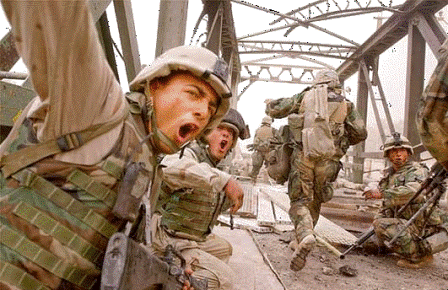
American Troops in the 2003 Iraq Invasion
At first glance, the answer seems as though it should be easy to find. Surely someone must have counted. Historians have written shelves of books about American wars. Governments maintain official lists of military campaigns. There are databases cataloging everything from Civil War regiments to individual Medal of Honor recipients. Yet after searching for quite some time, I discovered that no one appeared to have asked the question in precisely this way. We know when wars began and ended. We know when treaties were signed. But no one seemed to have examined each Independence Day individually and asked whether Americans were actively engaged in combat on that particular Fourth of July.
That realization turned what I expected would be a pleasant afternoon’s diversion into a genuine research project. Over the past several days I’ve assembled what I now call America’s Wartime Independence Days Database, examining every Independence Day from July 4, 1776, through the nation’s 250th birthday in 2026. The work quickly became more complicated than I ever imagined. Declared wars were easy enough. The Revolutionary War, the Civil War, the two World Wars, Korea, Vietnam, and the wars in Iraq and Afghanistan practically classified themselves. The real challenge lay in the gray areas that historians have debated for decades.
Should the long series of Indian Wars count? I believe they should. They were certainly wars to the soldiers on the frontier, and they were unquestionably wars to the Native nations fighting to preserve their homes and way of life. What about Marines conducting counterinsurgency operations in Nicaragua during the Banana Wars? Or American pilots enforcing the no-fly zones over Iraq throughout the 1990s? What of military advisers accompanying South Vietnamese units into combat years before most Americans realized the United States had become deeply involved in Vietnam? Each question required more reading, more official histories, and more judgment than I initially anticipated.
One principle gradually emerged as the foundation for the project. Rather than asking whether Congress had formally declared war or whether the American public perceived itself to be at war, I found myself asking a much simpler question: Were Americans fighting an enemy somewhere in the world? If American servicemen or women were engaged in sustained combat on the Fourth of July, then that Independence Day deserved to be considered a wartime Fourth, regardless of the legal terminology attached to the conflict. That standard does not eliminate every difficult decision, but it provides a remarkably consistent way of looking at two and a half centuries of American military history.
The preliminary results surprised me. Although the database will undoubtedly continue to evolve as additional sources are consulted, it appears that Americans have spent roughly two out of every three Independence Days while their armed forces were engaged in active combat somewhere in the world. Equally surprising was the realization that the longest continuous stretch of wartime Fourths did not occur during World War II or Vietnam, but during the era that followed the Spanish-American War, when the Philippine Insurrection, the Boxer Rebellion, the Moro campaigns, and other overseas interventions blended into more than two decades of almost uninterrupted military operations.
Perhaps the most enjoyable part of the project has been discovering how history resists tidy labels. Some years that appear peaceful at first glance become far less so after examining official Marine Corps histories, Army campaign studies, or declassified government documents. Other years that popular memory associates with war turn out to have been surprisingly quiet by the Fourth of July. One of the unexpected pleasures has been following the evidence wherever it leads, even when it overturns my own assumptions. That, after all, is one of the reasons historians continue researching subjects that seem, at first glance, to have been settled long ago.
There is one small mathematical curiosity worth mentioning. This year marks America’s 250th birthday, yet the database actually begins with July 4, 1776, the day independence was declared. If one counts every individual Fourth of July from 1776 through 2026, there are technically 251 Independence Days in the chronology. For the sake of clarity, and because the nation quite properly celebrates its 250th birthday this year, I chose to frame the discussion around America’s first 250 years while retaining that initial Independence Day as the starting point for the database itself.
This project is still very much a work in progress. I fully expect to revisit individual years, reconsider difficult classifications, and perhaps even change my mind when new evidence appears. That is not a weakness of historical research; it is one of its strengths. Every good database should improve over time, and I hope this one will do exactly that. If nothing else, I hope it encourages readers to think about Independence Day from a slightly different perspective. While most of us celebrate beneath peaceful summer skies, countless generations of Americans have marked the nation’s birthday under very different circumstances. Remembering them seems an appropriate way to celebrate the ideals first proclaimed in Philadelphia 250 years ago.
Note: Given the apparent inconclusive results of the “truce” with Iran in the current war, this year’s July 4th is counted as an “at war 4th.”