The Long Conflict Between the United States and Cuba
Cuban-American Wars and Conflicts
The history between the United States and Cuba has been marked by repeated military interventions, covert operations, political hostility, economic warfare, and ideological confrontation. From the era of the Spanish-American War in the 1890s, through the Cold War struggles against Fidel Castro’s Communist regime, and continuing into the current tensions between the Trump Administration and the Cuban government, the conflict between Washington and Havana has lasted for well over a century.
The origins of this long-running conflict lie in the Spanish-American War of 1898. Cuba had been fighting for independence from Spain, with the American public openly sympathizing with the rebels and American business interests also.pushing for intervention for economic reasons. The mysterious destruction of the American battleship USS Maine in Havana Harbor provided the spark that gave the United States a reason for war against Spain. The U.S. military quickly defeated Spanish forces in Cuba. While Cuba formally gained independence after the war, the United States occupied the island from 1898 to 1902.
This first American occupation of Cuba reshaped the island politically and economically. The United States forced Cuba to accept the Platt Amendment, which granted Washington the right to intervene militarily in Cuban affairs and allowed the United States to maintain a naval base at Guantanamo Bay. Cuba became a de facto American protectorate during the early Twentieth Century.
American military intervention soon became a recurring feature of Cuban politics. The United States occupied Cuba a second time from 1906 to 1909 after political instability and violence threatened the Cuban government. U.S. Marines and Army troops restored order and supervised Cuban political affairs during this period. Another intervention occurred in 1912, when American forces landed to protect American economic interests during a rebellion by Afro-Cuban groups. U.S. military forces again intervened during political unrest from 1917 to 1922.
These repeated occupations and interventions created long-term resentment among many Cubans. To supporters of American policy, the interventions were necessary to stabilize Cuba and protect American citizens and business investments in Cuba. To Cuban nationalists, however, the island was being treated as a colony dominated by Washington and American business interests.
The rise of Fulgencio Batista deepened this dynamic. Batista first rose to power through military coups in the 1930s and ruled Cuba as a dictator who did the bidding of the United States. American tourism, organized crime (i.e. The Mob), and American corporations became deeply entrenched in the Cuban economy. While some Cubans prospered, corruption and inequality became major issues.
This environment helped produce the Cuban Revolution led by Fidel Castro. Beginning with Castro’s failed Moncada Barracks attack in 1953, Castro and his followers launched a guerrilla campaign against Batista’s government. Castro’s revolutionary movement grew, and the Cuban Revolution culminated in Batista fleeing Cuba on January 1, 1959, and Castro’s revolutionaries seized Havana.
At first, the United States was uncertain how to deal with Castro. However, relations rapidly deteriorated as Castro nationalized American-owned businesses and allied Cuba with the Soviet Union, with Castro declaring that he was a Communist. This all occurred in the midst of the Cold War, and Soviet-aligned Communist Cuba became America’s primary enemy in the Western Hemisphere.
As is the case when a new regime takes power, leftover forces from the past regime often take up arms. This historical trend unfolded in Castro’s Cuba, as followers of the old Batista regime, along with ardent anti-Communists, began their own guerrilla campaign. This anti-Castro and anti-Communist guerrilla campaign, was called the Escambray Rebellion, for the name of the mountainous region the new rebels operated in. These holdouts received aid from the United States’ Central Intelligence Agency (CIA) after Castro’s pro-Soviet stance became apparent.
The first major military confrontation between Castro’s Cuba and the United States was the Bay of Pigs invasion in April, 1961. Organized by the Central Intelligence Agency (CIA), the operation involved Cuban exiles trained and armed by the United States. The goal was to overthrow Castro’s government and spark an anti-Communist uprising inside Cuba.
The invasion was a disaster. The exile force landed at the Bay of Pigs but failed to gain widespread support from the Cuban population. Castro’s military rapidly crushed the invasion force. The failed operation humiliated the administration of President John F. Kennedy and strengthened Castro politically. It also pushed Cuba even closer to the Soviet Union.
This led directly to the Cuban Missile Crisis of 1962, perhaps the most dangerous moment of the Cold War. The Soviet Union secretly deployed nuclear missiles to Cuba capable of striking the United States without warning. American reconnaissance aircraft discovered the missile sites, leading President Kennedy to impose a quarantine, or naval blockade around Cuba.
For nearly two weeks, the world stood on the edge of nuclear war. American and Soviet forces prepared for possible conflict while negotiations took place behind the scenes. Eventually, Soviet Premier Nikita Khrushchev agreed to remove the missiles from Cuba in exchange for an American pledge not to invade Cuba and the later removal of American missiles from Turkey.
Though open warfare was avoided, the United States continued aggressive covert operations against Castro for decades. The CIA launched numerous assassination plots targeting Fidel Castro. These included poison pills, exploding cigars, sabotaged diving equipment, and cooperation with anti-Castro Cuban exiles and organized crime figures. Castro himself often joked publicly about the extraordinary number of assassination attempts against him.
As noted earlier, in addition to assassination efforts, the United States supported anti-Castro insurgents during the Escambray Rebellion of 1959-1965. American intelligence agencies also conducted sabotage operations and economic pressure campaigns against Cuba over the course of decades.
One major aspect of the conflict was the long-standing American embargo against Cuba. Beginning in the early 1960s, the United States imposed severe economic restrictions designed to isolate Castro’s regime. The embargo became one of the longest-running economic warfare campaigns in modern history.
Cuba also became involved in other Cold War conflicts throughout the world, often opposing American and other Western interests, while expanding Soviet and Cuban influence in Africa. Cuban troops fought in Angola, Ethiopia, and elsewhere in support of Soviet-backed movements. In Central America, Cuba backed the Marxist Sandinista rebels, as well as Marxist rebels in El Salvador and other nations. In the Caribbean, Cuba strongly supported the Marxist government of Grenada.
This connection helped trigger the American invasion of Grenada in 1983. After a violent internal power struggle inside Grenada’s Communist government, the United States launched Operation Urgent Fury. American officials feared that Grenada, supported by Cuba, could become another Soviet-aligned military outpost in the Caribbean. During the invasion, American forces fought both Grenadian and Cuban troops stationed on the island.
Even after the collapse of the Soviet Union in 1991, hostility between the United States and Cuba continued. Though relations briefly improved during parts of the Obama Administration, tensions later escalated again.
Recent events have once again intensified the confrontation. The United States has increased economic pressure on Cuba through expanded sanctions and fuel restrictions tied partly to Cuba’s support for the Venezuelan government. During the 2026 American raid that captured Venezuelan dictator Nicolas Maduro, Cuban military personnel connected to Maduro’s security forces suffered casualties during the raid.
In May of 2026 the United States government unsealed a federal indictment against former Cuban leader Raoul Castro over the 1996 shoot-down of civilian aircraft operated by the exile group Brothers to the Rescue. American prosecutors charged Raoul Castro and other Cuban officials with conspiracy and murder related to the deaths of four men during the incident. The indictment represents one of the most dramatic legal escalations in U.S.-Cuban tensions in decades.
Despite occasional but temporarydiplomatic openings, the conflict between the United States and Cuba remains unresolved. More than 125 years after the Spanish-American War, the relationship between the two nations continues to be shaped by military intervention, ideological hostility, economic warfare, and the lingering legacy of the Cold War. Few rivalries in the modern Western Hemisphere have lasted as long, or have produced as many political crises, covert operations, and moments of international danger, as the long conflict between the United States and Cuba.
See also: Wars and Conflicts of Cuba
A List of Major Incidents and Conflicts Between the United States and Cuba
Spanish-American War and First U.S. Occupation of Cuba (1898-1902)–The United States intervened in Cuba’s War of Independence against Spain following the destruction of the battleship, the USS Maine, in Havana Harbor. The American military victory over Spain resulted in Cuba becoming formally independent, but effectively under heavy American influence and military occupation. Cuba effectively became a satellite of the United States.
Second U.S. Occupation of Cuba (1906-1909)–Political instability and violence inside Cuba led the United States to intervene militarily once again. American forces occupied the island, restored order, and supervised Cuban political affairs until a new government was stabilized.
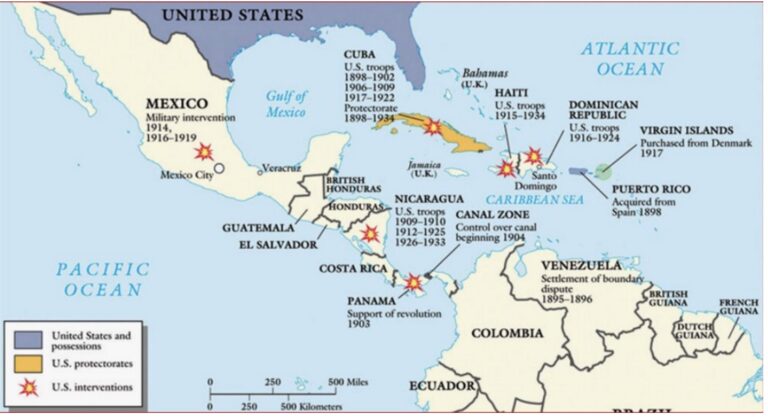
Map of U.S. Interventions in the Caribbean and Latin America
U.S. Intervention During Little Race War (1912)–The United States landed Marines in Cuba during an uprising involving Afro-Cuban rebels who were fighting the white-dominated Havana government. Washington justified the intervention as necessary to protect American citizens and business interests. Also called “The War of 1912.”
U.S. Intervention in Cuba During Political Unrest (1917-1922)–American military forces again intervened during a period of Cuban political instability and violence. U.S. troops protected sugar interests and helped maintain the pro-American Cuban government. This occupation also coincided with American involvement in World War One, and keeping Cuba stable was considered important to the U.S.
Cuban Revolution (1953-1959)–Fidel Castro and his revolutionary movement fought a guerrilla war against the dictatorship of Fulgencio Batista. Castro’s victory transformed Cuba into a Communist state closely aligned with the Soviet Union, creating decades of hostility with the United States.
NOTE: Following Castro’s victory, thousands of upper class Cubans fled Cuba for the United States. Many settled in the Miami area, and established a strong Cuban-American community.
Escambray Rebellion (1959-1965)–Anti-Castro guerrillas, many of them former Batista supporters and anti-Communists, fought an insurgency against Castro’s government in central Cuba. The CIA provided support to several anti-Castro factions during the rebellion until the failure of the 1961 Bay of Pigs invasion.
Bay of Pigs Invasion (1961)–The CIA organized, trained, and equipped Cuban exiles to invade Cuba and overthrow Fidel Castro. The invasion failed disastrously after Castro’s forces rapidly defeated the exile army, strengthening Castro’s rule and embarrassing the United States.
Operation Mongoose and CIA Assassination Campaign Against Castro (1961-1970s)
Following the failure at the Bay of Pigs, the United States launched covert operations against Cuba under Operation Mongoose. These included sabotage operations and multiple assassination attempts targeting Fidel Castro through poison, explosives, and other covert means. Castro survived all assassination attempts.
Cuban Missile Crisis (1962)–The Soviet Union secretly placed nuclear missiles in Cuba capable of striking the United States. After American reconnaissance aircraft discovered the missile installations, President Kennedy imposed a naval blockade around Cuba, creating a confrontation that brought the world to the brink of nuclear war before a negotiated settlement ended the crisis.
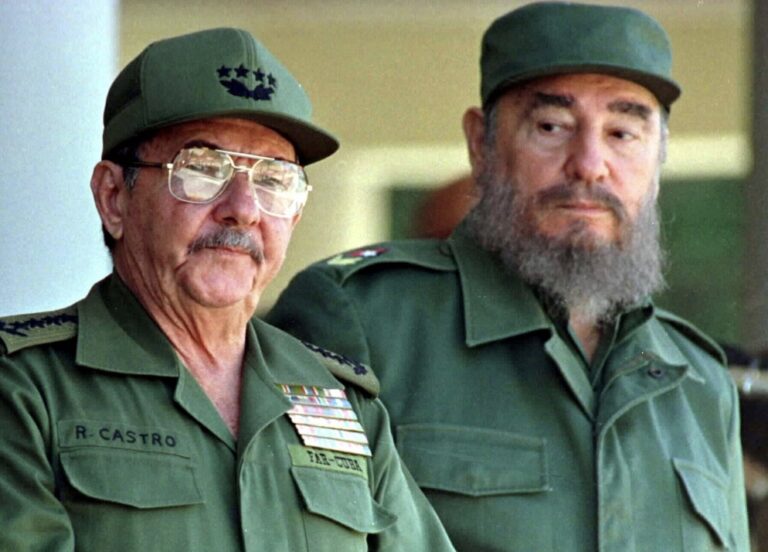
Raoul and Fidel Castro
U.S.-Cuba Economic Embargo and Cold War Confrontation–(1960s-Present)–The United States imposed sweeping economic sanctions and trade restrictions against Cuba after Castro nationalized American-owned property and aligned with the Soviet Union. The embargo became one of the longest-running economic warfare campaigns in modern history and remains a major source of hostility between the two nations.
Cuban Military Interventions Against U.S. Interests in Africa and Latin America (1960s-1980s)–Cuba deployed troops and military advisers to support Soviet-backed revolutionary movements and governments in nations such as Angola and Ethiopia. These interventions placed Cuban forces in indirect confrontation with American-backed armies and nations as part of the larger Cold War struggle between the United States and the Soviet Union.
Grenada Invasion/Operation Urgent Fury (1983)–The United States invaded the Caribbean island of Grenada after a violent internal power struggle within Grenada’s Marxist government. Cuban military personnel and construction workers stationed on the island fought American forces during the invasion, which Washington justified as necessary to prevent another Soviet-Cuban military outpost in the Caribbean.
Brothers to the Rescue Shootdown Incident (1996)–Cuban MiG fighter aircraft shot down two civilian aircraft belonging to the anti-Castro exile organization Brothers to the Rescue over international waters near Cuba. Four men were killed in the incident, sharply escalating tensions between Havana and Washington and leading to additional American sanctions against Cuba. The anti-Castro planes were engaged in a propaganda campaign.
Elián González Custody Crisis (1999-2000)–A political and diplomatic confrontation erupted between the United States, Cuban exile groups, and the Cuban government over six-year-old Elián González, who survived a dangerous attempt to flee Cuba by sea. The dispute became an international political crisis and a symbol of continuing tensions between Castro’s Cuba and the Cuban exile community in the United States.
U.S.-Cuba Proxy Conflict Over Venezuela (2000s-Present)–Cuba became one of the closest allies of the Venezuelan governments of Hugo Chávez and Nicolás Maduro. American officials accused Cuba of providing intelligence, military, and security support to the Maduro regime, while the United States backed Venezuelan opposition movements against the socialist government in Caracas.
Cuba and the Second Cold War (2010s-Present)–Though diplomatic relations briefly improved during parts of the Obama Administration, tensions later escalated again under subsequent American administrations. U.S. sanctions increased while Cuba strengthened relations with American rivals including Russia, China, Iran, and Venezuela.
Fuel Embargo and Escalating Economic Conflict (2025-2026)–The United States intensified economic pressure on Cuba through expanded sanctions and restrictions affecting fuel imports and shipping connected to the Cuban government. The resulting fuel shortages worsened Cuba’s economic crisis and increased tensions between Havana and Washington.
Maduro Raid and Related U.S.-Cuban Hostilities (2026)–Following American operations targeting Venezuelan ruler Nicolás Maduro and elements of his security network, reports indicated that Cuban personnel connected to Maduro’s regime suffered casualties or detentions during the operation. The incident intensified tensions between the United States and Cuba amid the broader Venezuela crisis.
U.S. Indictment of Raúl Castro (2026)–The United States brought criminal charges against former Cuban leader Raúl Castro and several Cuban military officials over the 1996 Brothers to the Rescue shootdown. Prosecutors charged Castro with conspiracy, murder, and destruction of aircraft, marking one of the most dramatic escalations in U.S.-Cuban hostility in decades.
In the aftermath of the Maduro Raid, as well as the Iran War (both in 2026), there is concern that the Trump Administration may seek a Maduro Raid-style regime change in Cuba soon.