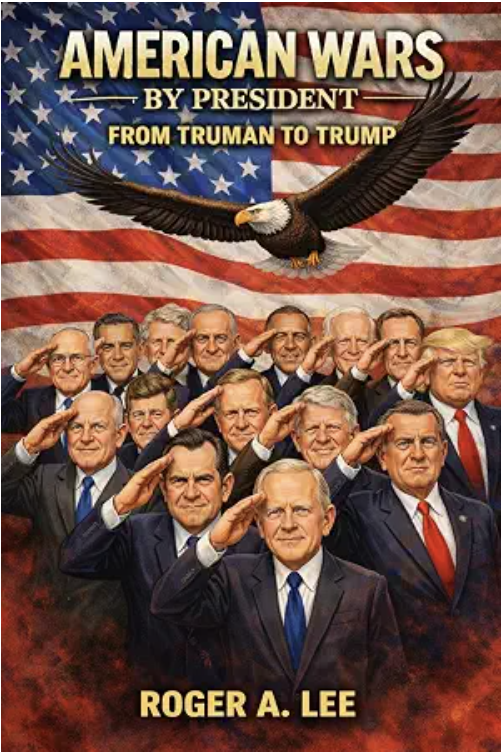
American Wars by President: From Truman to Trump, a new book, now available on Amazon
American Wars by President: From Truman to Trump : As readers of this website, you know my fascination with the history of military conflict. I have always been that guy who enjoys creating lists, including historical events.
The next logical step was to create a book from one of my many “war lists,” add narrative, and a bit of commentary, then publish. I examined the many wars fought by the United States since World War Two, and applied a rather simple (or so I thought) addition to the list: identify the wars connected to each president.
American Wars by President: From Truman to Trump is now available on Amazon as a Kindle Unlimited download (free if you subscribe to Kindle Unlimited), or as a paid ebook download for the low price of $3.99.
Here is a portion of the introduction to this book, and all of the wars under President Truman. Download the book to learn more about America’s wars from 1945 to the present day.
“The U.S. Constitution explicitly puts the president in a potential war-making role, as the Commander in Chief of the armed forces. While Congress retains the sole power to officially declare war, this power is largely unused by Congress and largely ignored by presidents. Not since World War Two has Congress actually declared war on anyone, yet, as shown in the text of this book, presidents DO use the military quite often. We look at the wars and military conflicts of the United States from Harry Truman in 1945 to the 2026 Iran War under President Trump.
Since Harry S Truman became president during World War Two, the United States has had 15 presidents (President Trump counts twice). They all have governed an America at war, dealing with varying degrees of conflict. Most of them, such as President Trump, who first took office in January of 2017, or President Biden, who took office in January of 2021, inherited wars begun or left over from their predecessors.
Each president has wars listed under two potential categories: Inherited or Initiated/Engaged.
An inherited war or conflict is one that was already ongoing when this individual became president. For example, World War Two was a conflict begun during the Franklin Roosevelt Administration. When Roosevelt died, Vice-President Truman became the new president and “inherited” that war.
A conflict considered Initiated/Engaged, is one that began or was joined by the U.S. during that president’s tenure. For example, even though it is considered part of the Cold War (inherited), the U.S. Invasion of Grenada in 1983 as a separate conflict, is listed as initiated/engaged, as it was itself a new conflict during the Reagan Administration.
Conflicts that are part of the Cold War between the U.S. (and allies) and the Communist powers of the Soviet Union and China (and their allies and satellites) are listed as part of the Cold War as a point of reference.
This is a listing of wars and conflicts under each president, beginning with the administration of President Truman in April 1945, through the current second administration of Donald Trump as of March 2026.
Wars of Harry S Truman (1945-1953)
Inherited:
World War Two: Truman became president upon the sudden death of President Franklin Roosevelt in April, 1945. The war in Europe was almost over, with Germany surrendering in early May, 1945. The war against Japan continued into August, when Truman made the decision to drop the newest weapon in the American arsenal, two atomic bombs, on Japan. After the second atomic bombing, Japan surrendered, with the formal signing of the surrender on September 2, 1945.
Initiated/Engaged:
The Cold War: U.S. involvement in the Cold War against the Soviet Union and associated communist states and organizations began under Truman’s watch. The generally recognized start of the Cold War is 1946.
U.S. involvement in the Korean War: North Korea invaded South Korea, and President Truman sent troops to defend South Korea and organized the United Nations’ armed defense against North Korea and China. The first major war as part of the Cold War.
Cold War Crisis/Incidents:
Soviet Occupation of Northern Iran (1946): The Soviets had occupied northern Iran during World War Two, and the British occupied the southern part of the country. After the war, the British left, but the Soviets remained, and set up two pro-Communist puppet states in northern Iran. The U.S. supported the Iranian government as the Iranians began military operations to take back the rebel territories.
Greek Civil War (1946-1949): U.S. supplied aid and military advisors to aid the Greek government against communist rebels.
Berlin Crisis of 1948 and Berlin Airlift: The Soviets cut off West Berlin from the rest of Europe by land, so the U.S. and Britain had to fly in supplies in what is called the Berlin Airlift.
Communist victory in the Chinese Civil War (1949): The U.S. supported the losing Nationalist Chinese side that then moved to the island of Formosa (now Taiwan), when they lost the war to the Chinese Communists, who were supported by the Soviet Union.”
Download the book to learn more about America’s wars from 1945 to the present day.
After you read this book, please leave a positive comment on Amazon. That will help the Amazon algorithm get the word out to other readers. Thank you!
https://www.amazon.com/dp/B0GYLPKDMJ
American Wars by President: From Truman to Trump Book