American Revolutionary War-Connected Conflicts
Connected Conflicts Introduction
This article is part of a series that explores the connections between various conflicts: wars, rebellions, political crises, and other major events that lead to or are connected with specific wars and military actions.
The first one we look at is the American Revolutionary War. The article starts with a very brief summary of the war itself and then looks at three types of connected conflicts:
- Predecessor Conflicts, which are prior related conflicts leading to the war we examine.
- Concurrent Conflicts, which are related conflicts occurring at the same time as the war we examine.
- Successor Conflicts, which are related conflicts occurring after the war we examine. If we are looking at a recent or currently ongoing conflict, this category may be incomplete or empty.
The American Revolutionary War (1775-1783), also known as the American War of Independence, was the conflict in which the Thirteen American Colonies of the British Empire broke away from British rule and established the United States of America. The war began after years of growing tensions over taxation, British military occupation, trade restrictions, and colonial demands for self-government. Fighting erupted at Lexington and Concord in April 1775 and gradually evolved into a global war involving Britain, France, Spain, the Netherlands, Nations in India, Native American nations, and various colonial factions. The conflict ended with the Treaty of Paris in 1783, in which Great Britain formally recognized American independence.
RELATED CONFLICTS:
Predecessor Conflicts
(Prior related conflicts leading to the American Revolutionary War)
French and Indian War [known as the Seven Years’ War in Europe] (1754-1763): The British victory over France in North America at the conclusion of this war greatly expanded British territorial control, but also left Britain heavily in debt. To pay this debt, and also to have the colonists pay for the war that was largely fought to protect the colonies, London imposed new taxes and regulations on the American colonies. contributing directly to rising colonial resentment.
Pontiac’s Rebellion (1763-1766): A coalition of Native American tribes launched attacks against British forts and settlements following the French and Indian War. Britain’s response included the Proclamation Line of 1763, which restricted colonial westward expansion and angered many colonists. Britain did this largely to prevent war with the Native tribes, which would also cost the government money.
Stamp Act Crisis (1765-1766): Colonial opposition erupted after Parliament imposed the Stamp Act, a direct tax on printed materials in the colonies. Protests, boycotts, and riots ensued. The political class in America began formulating many of the political arguments later used during the Revolution and in the arguments for independence from Britain.
British Military Occupation of Boston (1768): In response to rioting by the colonists, the Royal Governor of Massachusetts requested reinforcements, and London sent eight warships of the Royal Navy and 2,000 foot soldiers to occupy Boston. This only caused more rioting and protests by the colonists.
Boston Massacre (1770): Violence between British soldiers and Boston civilians culminated in the deaths of five colonists, who were shot by British troops who were under unarmed attack by the crowd. Patriot leaders used the incident as anti-British propaganda to inflame colonial opposition.
Boston Tea Party (1773): American colonists protested British taxation and trade policies by dumping East India Company tea into Boston Harbor. Britain responded with the harsh Coercive Acts, further escalating tensions.
First Continental Congress (1774): Delegates from twelve colonies met to coordinate resistance against British policies and organize colonial political opposition.
Battles of Lexington and Concord (1775): British troops attempting to seize colonial weapons clashed with colonial militia forces in Massachusetts. The fighting marked the beginning of the Revolutionary War.
Concurrent Conflicts
(Related conflicts occurring at the same time as the American Revolutionary War)
American Civil War Within the Colonies (1775-1783): The Revolution divided the colonial population between Patriots supporting independence and Loyalists supporting the British Crown. Violence, guerrilla warfare, political persecution, and local civil conflicts occurred throughout the colonies.
Native American Frontier Wars (1775-1795): Many Native American tribes allied with Britain in hopes of slowing American expansion westward. Frontier warfare became extremely brutal in regions such as New York, Kentucky, and the Ohio Valley.
Anglo-French War (1778-1783): France formally entered the war as an ally of the United States following the American victory at Saratoga. French military and naval support became critical to eventual American success. Combat between the British and French took place in the Atlantic, the Caribbean, in the American colonies themselves, and in India, where both had colonies. The French hoped to weaken their old foe, and exact some revenge for their defeat in the French and Indian War.
Second Anglo-Mysore War (1780–1784)-The Indian state of Mysore allied with the French to fight the British in India.
Anglo-Spanish War (1779-1783): Spain entered the conflict against Britain as an ally of France. Spanish military operations targeted British territories in Florida, the Gulf Coast, and the Caribbean.
Fourth Anglo-Dutch War (1780-1784): Britain went to war with the Dutch Republic after accusing Dutch merchants of assisting the American rebels. The conflict expanded the Revolutionary War into another global theater, with combat in the West Indies, European waters, and in Asia, where both nations had colonies.
Successor Conflicts
(Related conflicts occurring after the American Revolutionary War)
Northwest Indian War (1785-1795): After American independence, conflict erupted between the United States and Native American tribes resisting American settlement in the Northwest Territory. Most of these tribes had allied with the British against the Americans during the Revolution.
Shays’ Rebellion (1786-1787): Economic hardship and political dissatisfaction among former Revolutionary War soldiers and farmers in Massachusetts led to an armed uprising against state authorities.
French Revolution (1789-1799): The success of the American Revolution influenced revolutionary movements in Europe, particularly in France, where demands for liberty and republican government helped trigger revolution. The French government had incurred severe war debt in the American conflict, and this contributed to the instability of France post-war.
Haitian Revolution (1791-1804): Inspired partly by revolutionary ideas from both America and France, enslaved people in the French colony of Saint-Domingue revolted and eventually established Haiti as an independent nation. Also part of the French Revolutinary
Quasi-War Between the United States and France (1798-1800): Despite their wartime alliance during the Revolution, the United States and Revolutionary France later fought an undeclared naval conflict in the Atlantic and Caribbean.
War of 1812 (1812-1815): Long-standing disputes between the United States and Great Britain involving trade, naval impressment, and frontier conflicts eventually led to another war between the two nations.
Latin American Wars of Independence (1808-1830s): The American Revolution inspired independence movements throughout Latin America as colonial populations challenged European imperial rule.
American Expansion and Native American Wars (1780s-1890s): The creation of the United States accelerated westward expansion, leading to decades of warfare between the United States and Native American nations across North America.
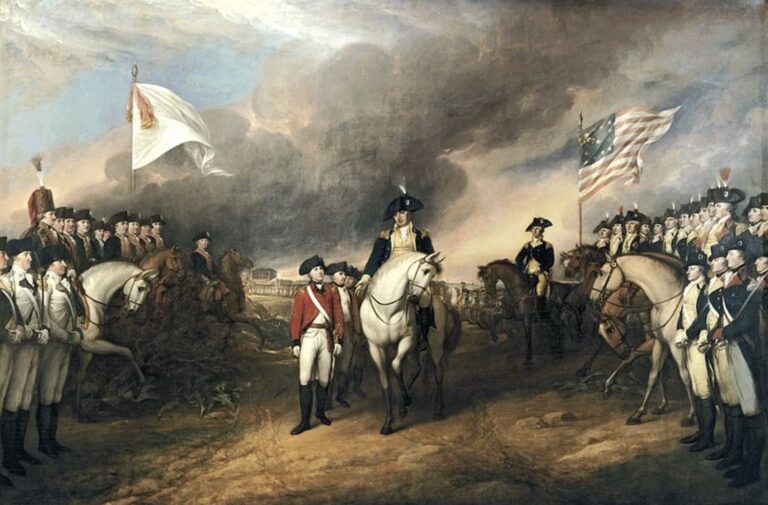
British Surrender at Yorktown 1781