Wars and Conflicts of Cuba
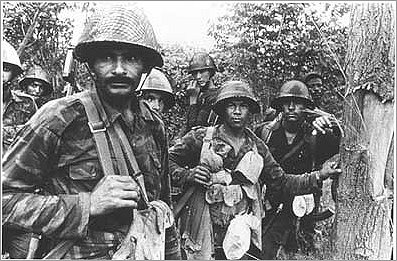
Cuban and Angolan Soldiers in the Angolan War
Historyguy.com>List of Wars by Nation>Wars of Cuba
Wars and Conflicts of Cuba: Cuba has a long history of wars and conflicts. From the Wars of Independence against Spain, the long history of conflict with the United States, to the Cold War military interventions by Fidel Castro as he sent Cuban troops to fight in African wars. Cuba has been heavily involved in revolutionary activities throughout Latin America, including intervening in Grenada, Venezuela, Nicaragua, El Salvador, and more. This article lists the wars of Cuba from the late 1800s to today.
Cuban Wars of Independence–15 years of war against the colonial Spanish rulers spread over 30 years in three separate Cuban uprisings. Cuban independence was guaranteed by the American intervention in 1898 and the final defeat of Spanish forces.
Ten Years War in Cuba/The Big War (1868-1878)
Little War (1879-1880)–was the second of three conflicts in the Cuban War of Independence. It followed the Ten Years’ War of 1868–1878 and preceded the War of ’95, itself sometimes called the Cuban War of Independence, which bled into the Spanish-American War, ultimately resulting in Cuban independence.
The Little War began on August 26, 1879, and after some minor rebel successes, the war ended in a Spanish victory by September 1880.
Cuban War of Independence (1895-1898)-Cuban independence was achieved largely through U.S. intervention (the Spanish-American War), though after the war, Cuba became a virtual satellite of the United States.
Spanish-American War (1898)
American Occupation of Cuba (1906-1907)
Cuban Revolt of 1917
Cuban Students Agitation (1930)
Cuban ABC Terrorism 1930-33
Gibara Rebellion in Cuba (1931)
Cuban Military Rebellion (1933)
First Batista Coup (1933)
Second Batista Coup in Cuba (1952)
Wars of Fidel Castro
26th of July Movement in Cuba (1953)-Castro’s failed attack on the Moncada army barracks in Santiago de Cuba. Castro was captured and put on trial.
Castro’s Revolution in Cuba (1956-1959)-After being freed from prison in a government amnesty, Castro returned to Cuba to begin a guerrilla war in the countryside, that led to the fall of the Batista dictatorship, and the rise of Castro to lead Cuba.
See also Fidel Castro’s Second Declaration of Havana (Feb. 4, 1962)
Bay of Pigs Invasion (1961)-Anti-Castro Cuban exiles, heavily aided and supplied by the United States, attempted an invasion of Cuba at the Bay of Pigs. The invasion failed.
Cuban Missile Crisis (1962)-Following the Bay of Pigs attack, Castro sought closer military ties with the Soviet Union. The Soviets installed nuclear missiles in Cuba, prompting the Cold War crisis known as the Cuban Missile Crisis. This event nearly led to World War Three between the U.S. and the Soviets, but compromise was reached and the Soviet missiles were removed from Cuba.
Congo Civil Wars (1965)-The new African nation of Congo was torn by multiple rebellions and civil war following independence in 1960. In 1965, Che Guevara led about 120 Cuban guerrillas to Congo to provide expertise and leadership to the Marxist Simba rebels in Congo. After several months, Guevara and his surviving Cuban troops fled to Tanzania, ending Cuban involvement in the Congo Wars.
Bolivia (1966-1967)-After leaving Congo, Che Guevara traveled to Bolivia to bring a Castro-style revolution to that Andean nation. His guerrilla army, called Ejército de Liberación Nacional de Bolivia (ELN), and made up of a small number of Cubans and Bolivians, enjoyed some success against the poorly trained Bolivian military, but as American aid to Bolivia increased, the Bolivians and their CIA advisors hunted down the insurgents, capturing Guevara and killing him in October, 1967.
Support for Latin American and African Independence Movements (1960s-1991)-Cuba sent advisors overseas, and also brought rebels from many nations to Cuba for training. Anti-colonial and anti-Western forces that were trained and aided by Cuba in this period include those from Africa: Portuguese colonies of Angola, Mozambique, and Guinea-Bissau, along with Eritrea, Congo, and Namibia.
Latin American nations and forces aided by Castro’s Cuba include: Sandinista rebels of Nicaragua (and the Sandinista government of Nicaragua after 1979), Marxist rebels in Guatemala, El Salvador, Honduras, Colombia, Bolivia, Venezuela, and Peru, among others.
Eritrean War of Independence-Prior to the Marxist takeover of the Ethiopian government in 1974, Cuba, the Soviet Union, and other communist nations, had aided the Eritrean rebels against the pro-Western government of Ethiopia. After the Marxist overthrow of the old Ethiopian government, the Soviets decided that backing the Ethiopians was better policy for them. Cuba, however, was reluctant to halt aid to the Eritreans (who had received military training in Cuba beginning in the 1960s), for some time, and only reluctantly aided the Ethiopian military against the Eritreans. This is also the same time period in which the Cuban military was heavily involved in Ethiopia’s other war, against Somalia.
Ogaden War (1977-1978)-After Ethiopia’s new Marxist government allied itself with the Soviet Union, both the Soviets and Cubans supported the Ethiopians in defend against an invasion of the Ogaden region of Ethiopia (populated largely by ethnic Somalis) by Somalia. The role of Cuban military forces enabled the Ethiopians to defeat the Somali invasion.
Angolan Civil War-During the Angolan War of Independence against Portugal, Cuba and the Soviets had aided the Marxist MPLA rebel movement. After independence, a civil war broke out in Angola that saw the MPLA take control of the capital of Luanda, and became the de facto government. At this point, (1975), Castro saw Africa as a more fertile post-colonial environment for spreading Communist revolution. Cuba sent thousands of troops to Angola to fight alongside the MPLA against the non-Communist forces of the UNITA and the FNLA, both of whom were supported by the United States and South Africa. Cuban troops were in Angola from 1975-1991,
South African Border War-Cuba had long supported with training and material, the anti-South African and anti-Rhodesian nations and rebels of southern Africa. Part of the Angolan intervention by Cuba involved supporting the SWAPO guerrilla forces based in Southern Angola who were fighting for independence of their homeland, now known as Namibia, from South African rule. South Africa, in turn, was supporting the anti-Communist UNITA rebel army in southern Angola. These conflicts brought Cuban and South African troops into combat against each other.
Invasion of Grenada (1983)-A Marxist coup in the Caribbean island of Grenada in 1979, established a government friendly to Cuban interests, and Cuba began sending aid to that island. In October of 1983, political violence in Grenada provided an opportunity to the United States to invade and overthrow the Marxist forces in Grenada. Several hundred Cuban troops were on the island, which resulted in combat between U.S. and Cuban forces. Cuba suffered 25 killed, 59 wounded, and 638 captured.
Maduro Raid (2026)-When the United States conducted the nighttime raid on Caracas, Venezuela in January, 2026 to capture President Maduro, U.S. forces engaged in combat with Cuban troops. These Cuban soldiers were part of Maduro’s personal guard. Maduro and the Cuban government were very close allies. Among the dead were 32 Cuban military and intelligence personnel in Caracas. This was the first official Cuban-American combat since the Grenada Invasion of 1983.
Sources and Links:
Wars of Cuba–Onwar.com
History of the Cuban Liberation Wars
Cuba: Havana’s Military Machine-The Atlantic, August 1988
Thesis on Cuban involvement in Africa
The Encyclopedia of Political Revolutions
Cuba: Havana’s Military Machine-article in the Atlantic