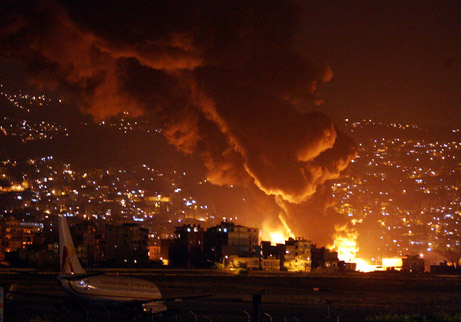
The Israel-Lebanon/Hezbollah War—(July 12, 2006-August 14, 2006): The latest chapter in the ongoing Arab-Israeli Conflict began on July 12, 2006, when guerillas from the Islamic Lebanese group, Hezbollah (Arabic for "Party of God), crossed into Israel and attacked an Israeli Defense Force (IDF) patrol, killing three and capturing two others. They then returned to southern Lebanon with their prisoners. Hezbollah's leader, Hassan Nasrallah, said the men were taken in order to set up a prisoner exchange with Israel. Israel's Prime Minister, Ehud Olmert, declared the attack an "act of war" on Lebanon's part, and promised a strong response.In Lebanon, this war is known as the "July War," while many Israelis call it the "Second Lebanon War."
Hezbollah launched "Operation True Promise" at 9:05 AM, on July 12, 2006. The operation began with a diversionary attack of rockets and mortar shells fired at Israeli settlements and military posts near the Israel-Lebanon border. Hezbollah troops then entered Israel, attacked two armored Israeli Humvees, patrolling the border village of Zar'it, with rocket propelled grenades, killing three soldiers and capturing two others. The Hezbollah force then retreated back into Lebanon with their captives, later identified as Ehud Goldwasser and Eldad Regev.
An Israeli Merkava Mark II tank that was stationed nearby attempted to pursue the captors into Lebanon in a rescue attempt, but was hit by an improvise explosive device (IED), killing all four crew members. Another Israeli soldier died during an attempt to recover the bodies from the destroyed tank
After Hezbollah's cross-border raid, the Israeli military launched air, naval, and ground attacks at Hezbollah targets across Lebanon, and Hezbollah responded by launching hundreds of rockets into northern Israel, many reaching as far south as the port city of Haifa.
Hezbollah also damaged an Israeli warship ten miles off the Lebanese coast with an Iranian-made unmanned drone, which rammed the ship and exploded.
Both sides continued to trade rocket, missile, and, artillery attacks, with most of the damage done to civilian targets on either side of the border. Israel's strategy seems to be to cut off Lebanon and Hezbollah from any aid they may receive from Syria or Iran, who are Hezbollah's main suppliers of weapons, money, and military training.
For a trans-border Arab-Israeli war, this conflict was different than most. Israel at first responded lightly in the ground war, apparently relying on the air and artillery campaign to inflict most of the damage. Hezbollah responded with wave after wave of rockets and missiles supplied largely by Syria and Iran over the past several years. Some of the larger Hezbollah rockets were able to strike the Israeli port city of Haifa, inflicting damage and causing civilian casualties. The Israeli strategy seemed two-fold: cut off Hezbollah from its suppliers and allies in Syria and Iran, while also striking Lebanese infrastructure targets with no apparent connection to Hezbollah. Israel hoped to show the Lebanese government and people that Hezbollah brought death and destruction to their county, hoping that this lesson would turn popular opinion against the Shiite militia. The opposite effect seems to have taken hold, however, with most Lebanese Muslims increasing their approval or outright support for Hezbollah, while even Lebanese Christians, normally not friendly to Islamic parties or militias, blamed Israel for attacking civilian targets as an act of punishment. While this political and psychological goal failed, Israel also failed to stop Hezbollah rocket attacks on Israeli cities and towns. The air campaign did not work in terms of increasing Israeli civilian safety during the war.
The ground campaign also seemed lacking. Unlike past wars, such as the 1956 war against Egypt or the 1967 war against Egypt, Syria and Jordan, or the 1982 invasion of Lebanon, the Israeli military did not immediately launch powerful assaults on the ground to root out and destroy their foes. Ground attacks did occur, largely from the second week on, but these were individual assaults to take or neutralize specific targets fairly close to the border. One significant commando assault did take place in the northeastern Lebanese city of Baalbeck, but that was designed as a specific attack to seize individual Hezbollah leaders. Only in the days leading up the United Nations-brokered cease-fire in the middle of August did the Israeli military launch a powerful drive which took it to the Litani River in southern Lebanon.
On Hezbollah's side, the war showed that their guerillas, though technically only a militia, possessed the training and fighting ability of a well-trained army division. Technologically, they surprised Israel with the depth and range of its missiles. One missile crippled an Israeli naval ship and sank a commercial freighter off the Lebanese coast in the early days of the war. Iranian-made missiles landed as far south as Haifa. For the first time since before the 1967 war, major Israeli civilian population centers came under attack.
The war also showed once again that the Lebanese government is helpless to defend its own territory or to keep other countries from fighting proxy wars and conflicts on its land. Just as when the Palestine Liberation Organization (PLO) moved in and took over southern Lebanon in the 1970s to fight its war with Israel, the government shows that it cannot stop Lebanon from being a battleground for others.
By August 12, Israel, Lebanon, and Hezbollah all agreed to a United Nations cease-fire to begin on Monday the 14th.
This war is a part of the wider Israel-Lebanon Conflict which dates from the first Israeli invasion of Lebanon in 1978.
On March 19, 2007, Israel formally declared the 2006 conflict with Lebanon's Hezbollah guerrillas a war, but Israel is searching for a name for the 34-day conflict.
On Wednesday July 16 2008, Israel and Hezbollah initiated deal whereby Hezbollah turned over the bodies of the two captured Israeli soldiers, Ehud Goldwasser and Eldad Regev, in exchange for Lebanese prisoner Samir Kuntar, four Hezbollah militants captured during the war, and the bodies of approximately 200 other Lebanese and Palestinian militants held by Israel. This prisoner swap prompted some criticism in Israel, especially after it was learned that Samir Kuntar was one of the released prisoners. Kumar and the other released militants, were greeted by a hero's welcome in Beirut.
UN criticizes rocket attack on Israel--CNN, Sept. 13, 2009
Goldwasser and Regev Were Killed in Initial Attack--Israeli National News.com--July 17, 2008
Outside Links on the Israell-Lebanon War of 2006
Combat Studies Institute --Operation Peace for Galilee. From Globalsecurity.org
Israeli navy commander resigning over failure in 2006 Lebanon war
1982 Lebanon War - Wikipedia, the free encyclopedia
Olmert: We were attacked by a sovereign country: YNetnews--video clip of Prime Minister Olmert speaking about the July 12 Hezbollah attack. 7-12-06
Eight IDF soldiers killed, 2 kidnapped on northern frontier:Jul. 12, 2006 9:37-The Jerusalem Post article in which Prime Minister Olmert calls the Hezbollah attack an "act of war." 7-12-06
Israel, Hezbollah Vow Wider War: At Least 66 Dead in Lebanon; Militia Strikes Warship at Sea--Washington Post 7-15-06
From Wikipedia:
Military operations of the 2006 Israel-Lebanon conflictHizbullah's real goal is racist: To free the Middle East holy lands of Jews--By Alan M. Dershowitz --Opinion piece from the Christian Science Monitor
Bint Jbeil: Hezbollah heartland --BBC article on a Hezbollah stronghold
Israeli Media
Yedioth Ahronoth - Israel at War
Lebanese Media
Lebanon under Siege - Lebanese government
Roadmap to Victory - The Center for Democracy in Lebanon
History Will Judge Us All On Our Actions--by Michel Aoun in The Wall Street Journal-July 31, 2006
Lebanon Live News --Lebanese television station
Hezbollah Media
Al-Manar TV - Hezbollah television station.
Israeli Blogs
The Muqata — Israel@War: Special Edition at the Mukataa blog
Israel North blog - A compilation of blogs by Russian-speaking residents of northern Israel, translated into English
Kishkushim — Written mainly by Carmia, a resident of Haifa
Idan Gazit — A New York born Israeli immigrant
Lebanese Blogs
BloggingBeirut.com — Finkployd's and other's regular war dispatches from Beirut, as featured in the New York Times
Live from Lebanon Diaries — "Commentary, analysis, human rights and development information, and diaries from on the ground"
Lebanese Political Journal — In-depth analysis on the political situation in Lebanon
Israeli Losses
Lebanese/Hezbollah Losses
95 soldiers killed
345 soldiers wounded
2 captured soldiers (later returned after their deaths)
1 warship damaged
1 tank destroyed
41civilians killed
1,293 civilians wounded
300,000 civilians have been displaced by the fighting
as of 8-12-06
1,130 Lebanese civilians killed
3,600 Lebanese civilians wounded
800,000 civilian refugees displaced by the fighting
36 Lebanese Army soldiers killed
100 Lebanese Army soldiers wounded
400 Lebanese Army soldiers captured
65 Hezbollah troops killed
(Israel claims to have killed 530 guerillas)
20 Hezbollah troops captured
as of 8-12-06
PREDECESSOR: (Related conflicts that occurred before)
1948 Arab-Israeli War (1948-1949)Suez/Sinai War (1956)
1967 Arab-Israeli War (1967)
War of Attrition (1968-1970)
1973 Arab-Israeli War (1973)
Jordanian Civil War (1970)
CONCURRENT: (Related conflicts occurring at the same time)
Israel-Palestinian Conflict (1964-Present)Lebanese Civil War (1975-1991)
Israel-Lebanon Conflict (1978-Present)
Syrian Intervention in Lebanon (1975-Present)
U.S. Intervention in Lebanon (1982-1984)
SUCCESSOR: (Related conflicts that occur later)
"The History Guy" is a Registered Trademark.