The Invasion of Grenada
(1983)
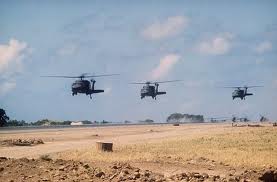
UH-60A Black Hawks over Port Salinas,invasion of Grenada, 1983
NAME OF CONFLICT: The U.S. Invasion of Grenada
ALTERNATE NAMES: Operation Urgent Fury (US)
BELLIGERENTS:
United States and the Organization of Eastern Caribbean States
vs.
Grenada and Cuba
DATES OF CONFLICT:
BEGAN: October 25, 1983
ENDED: December, 1983
TYPE(S) OF CONFLICT: Inter-State (between nations)
RELATED CONFLICTS:
PREDECESSOR CONFLICTS:
CONCURRENT: The Cold War, U.S. Intervention in Lebanon (1982-1984), Nicaraguan “Contra” War (1982-1990)
SUCCESSOR CONFLICTS:
CAUSES OF CONFLICT:
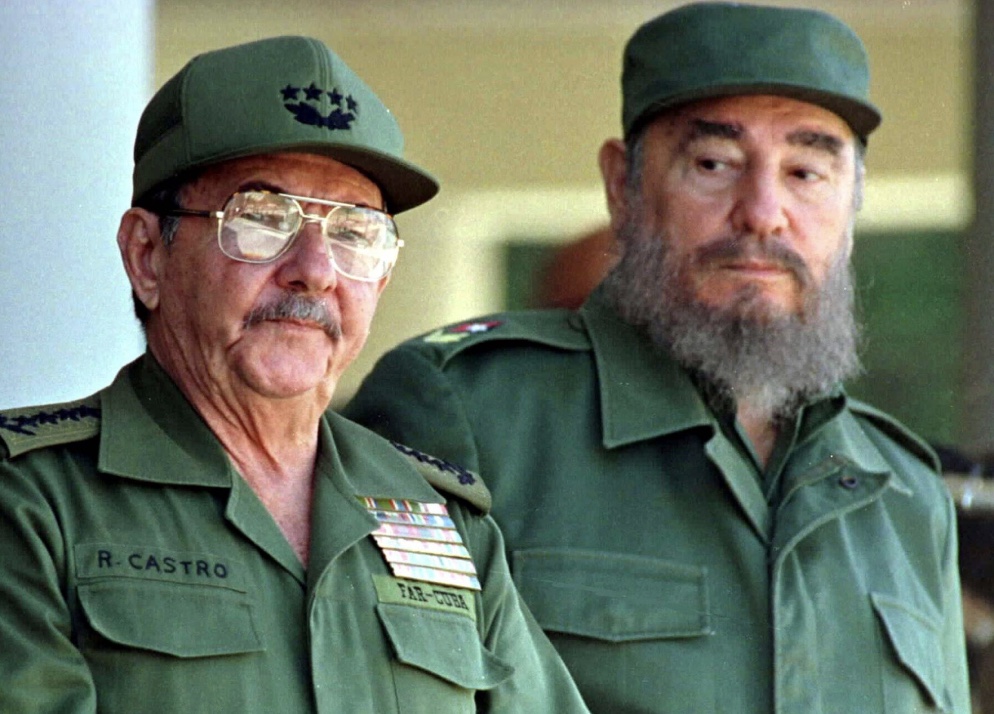
The U.S. invasion of Grenada and the toppling of its Marxist government can be seen as part of a greater regional conflict. This conflict involved the U.S. and its Central American and Caribbean allies on one side and Fidel Castro’s Cuba, the Sandinista government of Nicaragua and various Marxist guerrilla armies on the other. President Reagan and his administration were concerned that the Marxist government of Prime Minister Maurice Bishop was allowing Cuba to gain undue influence in Grenada, specifically by constructing a military-grade airport with Cuban military engineers.
On October 13, 1983, the Grenadian Army, controlled by former Deputy Prime Minister Bernard Coard, seized power in a bloody coup. The severity of the violence, coupled with Coard’s hard-line Marxism, caused deep concern among neighboring Caribbean nations, as well as in Washington, D.C. Also, the presence of nearly 1,000 American medical students in Grenada caused added concern.
However, along with concern, came opportunity. With President Reagan’s worldwide efforts to confront what he viewed as the threat by the Soviet Union and other Communist countries (such as Cuba), the turmoil in the Caribbean provided a timely excuse to eliminate a Marxist government and give Fidel Castro a black eye.
It should also be noted that on October 23, 1983, American foreign policy and pride suffered a terrible shock when a Muslim suicide bomber destroyed the Marine barracks in Beirut, killing 240 U.S. Marines. A successful campaign in Grenada would prove helpful in alleviating the pain of that setback.
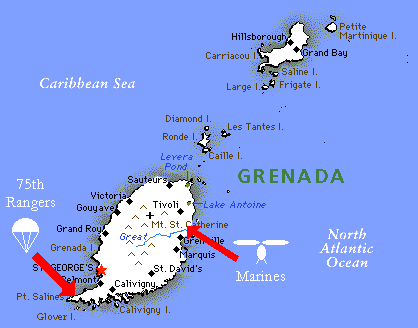

DESCRIPTION OF CONFLICT:
In the early morning of October 25, 1983, the United States invaded the island of Grenada. The initial assault consisted of some 1,200 troops, and they were met by stiff resistance from the Grenadian army and Cuban military units on the island. Heavy fighting continued for several days, but as the invasion force grew to more than 7,000, the defenders either surrendered or fled into the mountains. Scattered fighting continued as U.S. troops hunted down stragglers, but for the most part, the island quickly fell under American control. By mid-December, U.S. combat forces went home and a pro-American government took power.
CONSEQUENCES OF CONFLICT:
1. The Marxist, pro-Cuban governments of Bishop and Coard were eliminated and a regime friendly to American interests took over.
2. The Reagan Administration proved willing to use force to combat what it considered hostile governments in the area.
3. America’s European allies expressed disapproval of the unilateral invasion of Grenada.
4. The invasion sent a message to Cuba and Nicaragua that they could only go so far in exporting revolution in Central America and the Caribbean without provoking an American military response.
5. As a result of the Cuban defeat in Grenada, Colonel Pedro Tortolo, who was the commander of Cuban military personnel on Grenada when the U.S. forces invaded, was court-martialed and sent to Angola as a private, along with most of his Grenada command.
CASUALTY FIGURES:
U.S.— 19 dead (officially).
Grenada— 49 dead and several hundred wounded.
Cuba— 29 dead and over a hundred wounded.
UNIQUE FACTS OR TRENDS:
1. This was the first “war” between the U.S. and Cuba. Though some would say that the Bay of Pigs Invasion of 1961 could fall into that category, we do not count the Bay of Pigs in the category of an “official” shooting war or conflict.
2. Grenada was America’s first military victory since well before the Vietnam War.
3. This was the first time since before World War Two that an avowed Communist/Marxist government had been replaced with a pro-Western one. It should be noted though, that some governments which the United States and her allies claimed were communist (like the Arbenz government of Guatemala and the Mossadegh regime in Iran) did fall due to covert American (CIA) action. Again, we do not count them since they did not officially proclaim allegiance to the communist ideology or become overt allies of other communist nations.
Something new and historical: Want to learn how to drive a tank? Check out these tank driving experiences.
SOURCES:
1. Kohn, George C. Dictionary of Wars. New York: Facts On File Publications. 1986.
Get MCSA 2003 demos for ccda exam training when you cissp certification with 100% success guaranteed. Our high quality 642-902 prepares you well before appearing in the final exams of VCP-510 study guide.
LINKS
See also: Wars of Cuba
Joseph Metcalf III Dies at 79; Led Invasion of Grenada
The Military History of the Ranger: Grenada Invasion An account of the U.S. Army Rangers in action in Grenada.
Operation Urgent Fury A good source for links on the Grenada conflict.
U.S. Casualties from Operation Urgent Fury–From the U.S. Army web site.
Lebanon And Grenada Transcript of President Reagan’s address to the nation regarding the bombing of the Marine barracks in Lebanon and the U.S. invasion of Grenada. Part of a larger Ronald Reagan website.
Great Events IV: The Invasion of Grenada Primarily a political analysis of the reasons behind the Grenada invasion. Serves as a good summary. These articles are excerpted from Great Events VI, based on reporting by The New York Times.
The Grenada 17 Homepage–Supports of the release of fourteen former members of the Grenada government of 1979 to 1983 and the three soldiers imprisoned with them.
Fort George Grenada, West Indies–Very interesting history of a military fort in Grenada, from colonial times to the U.S. invasion. This fort was previously known as Fort Rupert.
Grenada Revolution Online–Learn the basics of the story of The Grenada Revolution online. In 1983, the United States was part of Grenada’s history. Discover what happened and why.