(1999-Present)
Historyguy.com
(1999-Present)
NAME OF CONFLICT:
The Second Chechen War (1999-Present)
ALTERNATE NAMES FOR CONFLICT: Operation Horseshoe (Russian)
The Dagestan War (first phase of conflict)
BELLIGERENTS:
Islamic Chechen and Dagestani Rebels (calling themselves the "Islamic Republic of Dagestan") and the "independent" region of Chechnya
vs.
Russia
DATES OF CONFLICT:
BEGAN: August, 1999 ENDED: Continuing
TYPE(S) OF CONFLICT:
RELATED CONFLICTS:
PREDECESSOR: (Related conflicts that occurred before)The Chechen War (1994-1996)CONCURRENT: (Related conflicts occurring at the same time)
None at this time.SUCCESSOR: (Related conflicts that occur later)
None at this time.
CAUSES OF CONFLICT:
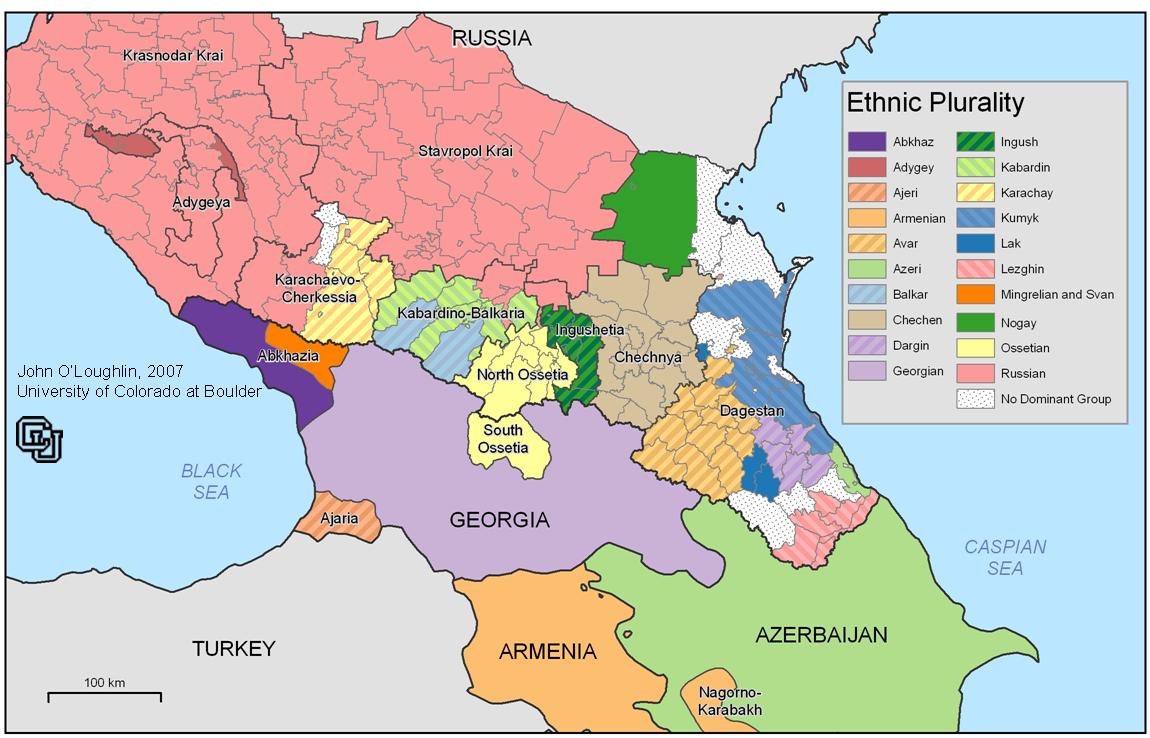
In order to understand the roots of the conflict in Russia's South Caucasus region (Chechnya, Dagestan, Ossetia, Ingushetia), an examination of the historical conflicts in that part of Russia in general, and Chechnya in particular, is necessary. The area in southern Russia known as the Caucasus Region is home to a large variety of non-Russian ethnic groups, many of whom follow the Islamic faith and want little to do with the government of Russia. After the communist Soviet Union disintegrated in 1991, the three southernmost Soviet Republics declared independence: Armenia, Azerbaijan and Georgia. The areas immediately north of these new nations remained part of the new Russian Republic, though their populations largely were not Russian. Several of these ethnic groups began agitating for more autonomy from Moscow or for outright independence.One of the more vocal groups were the Chechens; a group with a long and bloody history of opposition to Moscow's rule. During World War 2, the Communist Soviet government deported the whole Chechen population to Central Asia out of fear they were going to aid the invading Germans. Though they were allowed to return to their homeland decades later, the Chechen populace maintained their dislike of the Russian-dominated Soviet government. The Chechens declared themselves a sovereign nation in 1991. By 1994, relations between the breakaway government in Chechnya and the Russian government had drastically deteriorated. In December of that year, Russian forces attacked Chechnya, beginning a bloody, embarrassing conflict in which the Russian military proved rather inept. That war ended in August, 1996 with the Chechens claiming victory and independence, and the Russian government claiming victory and the retention of Chechnya as a part of Russia. In other words, both sides agreed to disagree and halted the major fighting. Clashes along the border continued as several Chechen rebel leaders and groups continued to harass the Russians in nearby areas. One such area is Dagestan, another largely Muslim (Islamic), region of southern Russia. Some Dagestanis are reported to have helped the Chechens in their war and some of the more radical Chechen war leaders wish to force Russia out of the area and unite the Muslim peoples of the Caucasus region. However, in comparison to Chechnya, Dagestan has over 30 separate ethnic groups, as opposed to the more homogenous population of Chechnya.
"Khattab", an Arab who is a militant leader of the fundamentalist Wahhabi Islamic movement and Shamil Basayev, a famous rebel leader from the First Chechen War, commanded of the guerrilla forces which invaded Dagestan. They are known to favor the unification of Chechnya and Dagestan. *This was written prior to the Russian invasion of Chechnya in 1999. Moscow used the Dagestan conflict as an excuse to end Chechnya's semi-independence.
The Chechen Campaign (2000-Present)
During the Dagestan Campaign, Russia suffered from several terrorist attacks in which powerful explosions destroyed apartment buildings in cities throughout the nation. At least 300 people died due to the explosions in September of 1999. Russia's government, then headed by President Boris Yeltsin, claimed that the Islamic rebels (meaning the Chechens) were responsible for the terrorism. Using this as an excuse to continue the Dagestan Campaign into Chechnya proved quite popular with Russian voters. After Yeltsin's retirement, Acting President Vladimir Putin won the March 2000 election largely on the strength of his continuing war against the Chechens and Islamic "terrorists."
DESCRIPTION OF CONFLICT:
Fighting broke out in August, 1999 in the Russian area of Dagestan as guerrilla forces infiltrated from neighboring Chechnya. Following months of clashes and tension in the border area of the semi-independent state of Chechnya and the Russian Republic of Dagestan, rebels seized control of several villages and battled Russian troops. Approximately 2,000 self-proclaimed Islamic rebels battled the growing numbers of Russian troops. The Russian government reinforced the 17,000 soldiers already in the region and carried out airstrikes against the rebels. Within the first six days of the war's outbreak, Russian warplanes flew at least 200 sorties.The local populace did not flock to the rebel banner, allowing the Russian forces the opportunity to take the initiative and drive the rebels out of Dagestan and back into Chechnya.
After driving the rebels from Dagestan, Russian forces pursued the rebels into Chechnya with the intent of ending the separatist republic's existence. To this end, a ruthless military push toward the Chechen capital of Grozny began. Learning from their failed 1994-1996 war against the Chechens, the Russians made extensive and heavy use of long-distance weaponry. Chechen cities and villages were leveled by intense Russian air attacks and artillery bombardment designed to maximize rebel losses while minimizing Russian casualties.
Russia now claims control of Grozny, but rebel units and snipers still fight on inside the city as the war turns to the countryside. The war then turned into a rural guerrilla conflict, and then, by 2002, into an urban terror campaign designed to weaken Russia's will to fight.
As the rural guerrilla war continues to simmer, the Chechen resistance has begun a bloody campaign in Russia's heartland. Continual bombings have struck terror in Moscow and other Russian cities as the Chechens target subways, concerts, commercial aircraft, theaters and, in September of 2004, the middle school in the town of Beslan, where hundreds of children and parents were killed. Chechen terrorists also set off suicide bombs in Moscow's Domodedovo airport on January 24, 2011, killing at least 35, and wounding over 150.
One of the allegations that Putin's government claims is that the Chechens hold ties to al-Qaida, the Islamic terror network founded by Osama bin Laden. Evidence exists to support this claim, which aids Moscow in its assertion that they, too are part of the world-wide War on Terror proclaimed by American President George W. Bush.
Russian losses continue to grow as they pursue the Chechen forces into the mountainous regions to the south. Also, areas that Russia claims are pacified periodically erupt in hit and run ambushes of Russian troops. The war for Chechnya does not appear to have an end in sight.
Russia's relations with the West originally were strained due to the harshness of the Chechen campaign, though American criticism lessened considerably after the 2001 attacks on the U.S.The April, 2013 Boston Marathon bombings carried out by two Chechen brothers that caused over 170 casualties brought the realities of the Chechen conflict to the United States. While at this writing (4.20.13), the exact motivation for why the Tsarnaev brothers planted the bombs is as yet unclear, what is clear is that in some small way, the Chechen conflict has assumed international dimensions. One of the known facts about the Tsarnaevs is that they entered the U.S. with their family as refugees from the Chechen War.
CASUALTY FIGURES:
Russia--Total Russian Military Deaths: 6,9883,725 Russian Army soldiers2,085 Interior Ministry troops
1,072 Chechen police officers
106 FSB and GRU officers
Russian Civilian Deaths: 600 (most from terrorist attacks inside Russia by Chechen forces)
Chechnya-- Militants: 14,113 killed
Civilians: Civilian deaths are thought to exceed 50,000.
SOURCES and NEWS on the CHECHEN CONFLICT:
Moscow bombing: Medvedev in Domodedovo airport pledge--BBC, Jan. 24, 2011Moscow fears 'war unleashed on its streets'--CNN, March 30, 2010
Dubai killing removes top rival to Chechen leader--Associated Press, April 6, 2009
The Dagestan War: Actors, Roots and Predictions-- Report from the Center for Defense Information
The Boston Globe: Russia's threat raises prospects of regionwide war in Caucasus
Christian Science Monitor: The Dagestan War and Beyond
British Broadcasting Corp.: Dagestan rebels hit hard--Includes map of region.
British Broadcasting Corp.: Analysis: Jihad or Russian conspiracy?
Time Magazine: Why Dagestan Smells Like a Recipe for Disaster
Russia Today: Key Facts And Figures About Russia's Dagestan--Contains good background information.
Russia Today: Chronology of Russian Involvement in the North Caucasus--Contains good background information.
Chechnya Timeline — Infoplease.com
Crisis in Chechnya — Global Issues
The Chechen Conflict-- From the BBC. Links to many news reports on the conflict.
Daghestan - Profile of the republic from the Caucasian Club.
Dagestan - Introduction to the area, with pictures, and maps that put the republic in geographical and ethnic context. From CaspianNet.
Radio Free Europe: Dagestan's Religious Tensions-Analysis-- A look at the problems between the Wahhabi and Tariqat Sufi Islamic orders in Dagestan.
Chechen Links Chechen Republic Online--Interesting background information in the "history" section.
Chechnya - Ethnic history of Chechnya
"The History Guy" is a Registered Trademark.